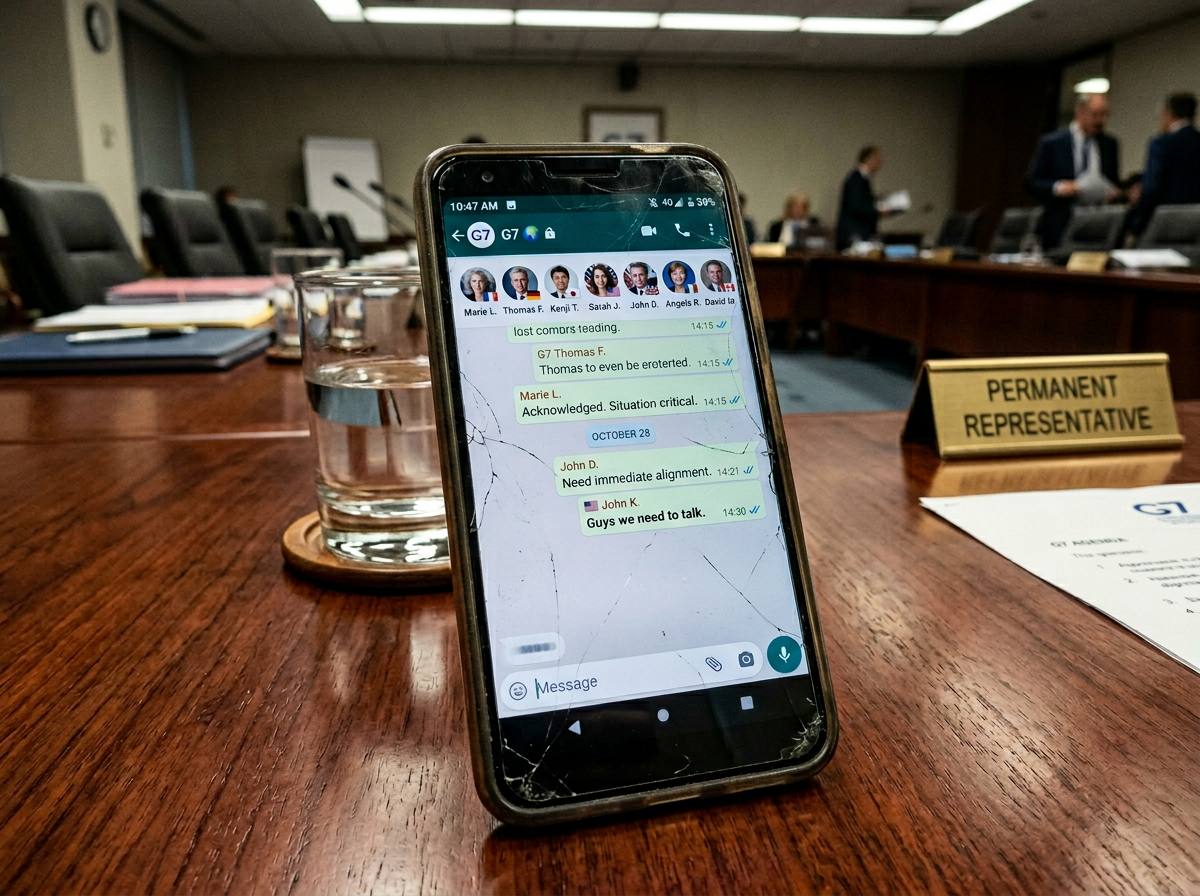
The message was sent eleven days ago. It has been read. The little ticks turned blue — both of them, traitorously blue — at 09:47 GMT on a Tuesday, the kind of Tuesday that always precedes something catastrophic. The message, authored by the rotating presidency and typed with the urgency of a man who genuinely believed in multilateralism, read: Guys we need to talk.
Nobody responded. But somebody is typing. You can see it. Three animated dots, pulsing at the bottom of the screen like a dying star, like the last heartbeat of the rules-based international order. The dots have been there for six days. Nobody knows who it is. Some say France. Others suspect it is an intern in Geneva running a simulation.
Welcome to modern geopolitics — conducted almost entirely through a WhatsApp group that no one wants to be in, cannot leave without causing a diplomatic incident, and reads only when they are directly mentioned.
I. The Group: A Brief History
The group — officially named G7 🌍🔒, though nobody remembers who added the lock emoji or why — was created during a summit in which everyone was photographed looking optimistic in front of a large flag. That photograph now hangs in at least three foreign ministries, three airport VIP lounges, and zero actual halls of power where decisions are made.
The group has 197 members, though only twelve ever post. The rest have notifications muted. One member — a Pacific island nation with a population smaller than a mid-sized Italian municipality — sends daily weather updates that nobody reads and everybody secretly appreciates.
The group has several pinned messages. One is a ceasefire agreement. One is a birthday wish to a former secretary-general. One is a PDF titled 'URGENT: Agenda for Friday' from 2019. Friday has not yet happened.
II. The Taxonomy of Non-Response
Political scientists have long studied the art of the non-response. But the group chat has introduced a new vocabulary of strategic absence. There is, for instance, the Diplomatic Scroll — the act of opening a message, reading it fully, and then scrolling past it as though it described someone else's problem. There is the Acknowledged Ignore — indicated by a reaction emoji, typically 🙏 or ❤️, which communicates empathy without commitment, solidarity without action, the geopolitical equivalent of a card signed by the whole office.
And then there is the most sophisticated manoeuvre of all: the Typing Indicator Without Message. This is advanced statecraft. It signals engagement without exposure. It buys time. It generates hope. Several peace negotiations in the past decade have been sustained entirely by typing indicators — three dots, breathing, reassuring — with no message ever arriving.
One senior diplomat, speaking on condition of anonymity from a mahogany table somewhere between Geneva and oblivion, described the typing indicator as 'the only honest thing left in international relations. At least the dots don't lie about what they are.'
III. What the Blue Ticks Know
The blue tick is the great exposer of our time. Before group chats, plausible deniability was the sovereign right of every government: we did not receive the communication, we have no record of the request, we are looking into it. The blue tick has abolished all of that. The blue tick says: you saw this. You saw this at 09:52 on a Tuesday morning, probably from a limousine, probably while someone handed you a briefing paper about something unrelated, and you chose — chose — not to respond.
There is currently no international convention governing blue ticks. This is perhaps the most significant regulatory gap of the twenty-first century. The Rome Statute covers crimes against humanity. The Geneva Conventions cover the conduct of war. Nothing covers the act of reading a message about an active conflict and responding with a 🙏 before returning to a state dinner.
Legal scholars at three institutions have begun preliminary research into whether sustained non-response in a group chat during a humanitarian crisis constitutes a form of wilful neglect under international law. Their findings, circulated via WhatsApp, have been read by all recipients. Nobody has replied.
IV. The Eternal Agenda
Every group chat has a moment of founding optimism — a summit, a handshake, a photograph with a large flag. In that moment, the group is created with great ceremony and sincere intentions. Someone types: great to connect, let us keep this channel open for coordination. Everyone agrees. A PDF is shared. The PDF contains an agenda. The first item on the agenda is: maintaining the channel.
The group then enters a long period of administrative messages — logistics, dietary requirements for a follow-up meeting that will be postponed twice, a poll about time zones in which the wrong option wins because someone voted by accident and nobody knows how to change it. Then a crisis arrives. Then: Guys we need to talk.
Then: blue ticks. Then: three dots. Then: eleven days of nothing, which is, historically speaking, exactly how it has always worked, except that now there is a timestamp.
V. Someone Is Still Typing
It is important, in closing, to note that the dots are still there. Someone, somewhere — in a capital city, in a bunker, in a climate-controlled conference room where the coffee is always fresh and the agenda is always pending — is still typing. The dots pulse. The message does not arrive. But this is not nothing. This is, in fact, the entire architecture of contemporary multilateralism: the permanent suggestion that a response is coming, maintained indefinitely, at very low cost, with very high optics.
The group chat is not a failure of communication. It is communication — distilled to its purest, most honest form. It says: we are here, we are watching, we have read the message, we understand the urgency, we are composing a thoughtful reply, and we will send it, we promise, as soon as the moment is right.
The moment has not yet been right for eleven days. But the dots are still going. And in this world, that counts as engagement.