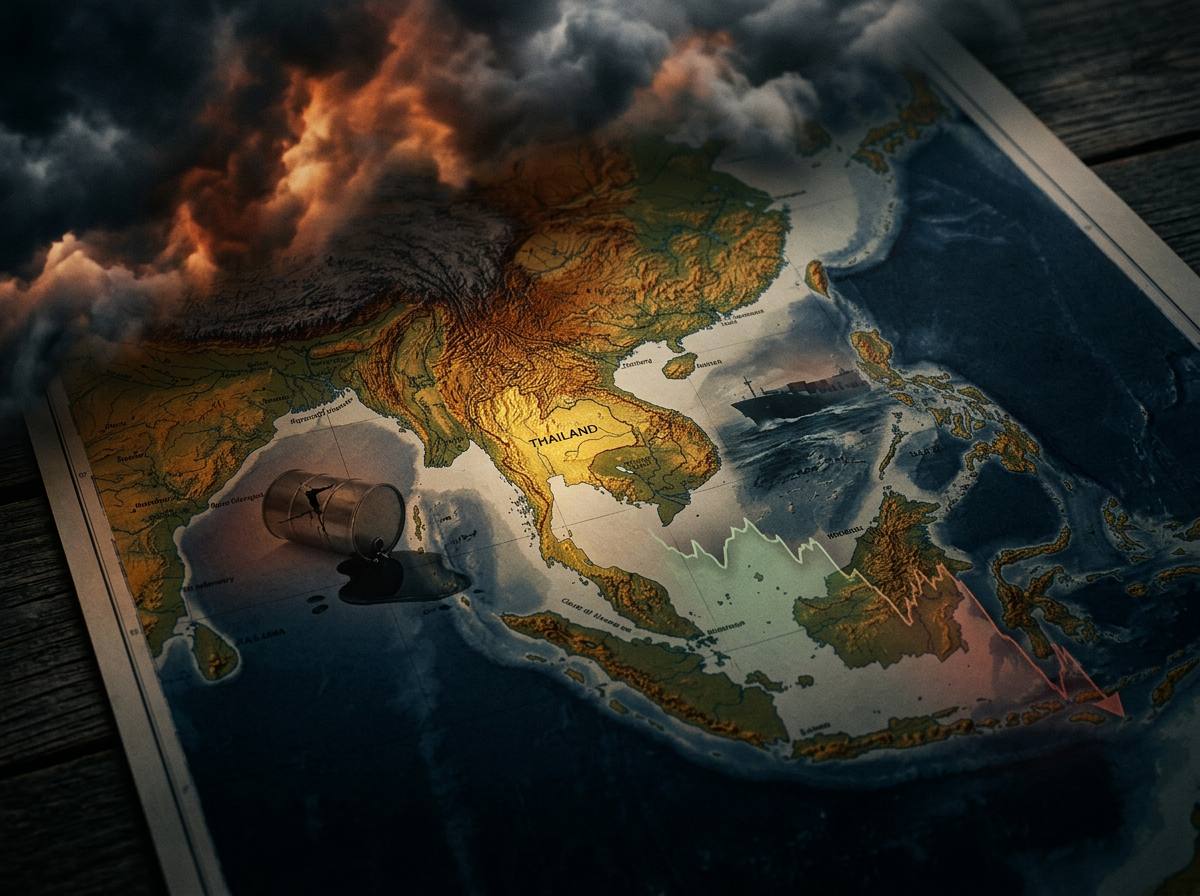
It began on February 28th, 2026, with B-2 stealth bombers and a codeword: Operation Epic Fury. By the time the first wave of strikes hit Tehran, Isfahan, and Qom, the ripple effects were already moving — not just through the Persian Gulf, but through global oil markets, shipping lanes, and the quiet economic calculations of countries that had nothing to do with starting the war. Thailand is one of them.
Bangkok is 5,500 kilometers from Tehran. There are no shared borders, no military alliances, no direct stakes in the question of Iranian regime change. And yet, in the week since the US and Israel launched coordinated strikes targeting Iran's leadership, nuclear program, and military infrastructure, the economic ground beneath Thailand has begun to shift — slowly, almost imperceptibly, but with the unmistakable weight of structural exposure.
This is what proximity to a world-altering conflict looks like when you're not in it.
The Oil Question
Thailand imports roughly 80% of its crude oil. The country doesn't have the strategic reserves of Japan, the sovereign wealth buffers of Singapore, or the domestic production capacity of Malaysia. What it has is an economy deeply wired into global energy pricing — and global energy pricing is now wired directly into what happens in the Strait of Hormuz.
Approximately 30% of the world's seaborne oil passes through that narrow chokepoint between Iran and Oman. Iran has threatened its closure before, and never followed through. This time, the calculation is different. Supreme Leader Khamenei was assassinated in the opening strikes. The IRGC has launched over 500 missiles and 2,000 drones across nine countries in the first four days alone. Tehran's response — Operation True Promise IV — is not the measured counterstrike of a regime preserving leverage. It reads more like an institution fighting for survival.
A full Hormuz blockade remains unlikely, but its probability has never been higher. Even partial disruption — insurance surcharges, rerouting, spooked tanker operators — could push oil prices to $130–$150 per barrel. For Thailand, that translates directly into fuel subsidies under pressure, petrochemical input costs spiking, and transport inflation bleeding into consumer prices across every sector from logistics to food delivery.
The Shipping Bottleneck Nobody Is Talking About
The oil price headline is obvious. Less discussed is what's happening to the physical movement of Thai goods. Roughly 40% of Thai exports transit Middle Eastern shipping lanes. The Port of Jebel Ali in Dubai — the largest port in the region and a critical transshipment hub for Southeast Asian cargo — sits inside the zone of active Iranian missile and drone strikes.
Iranian strikes have already hit Qatar, Bahrain, Kuwait, and Saudi Arabia. Qatari authorities confirmed they downed Iranian missiles targeting Hamad International Airport. Bahrain's international airport was hit by drone. A building in Manama's commercial district was struck.
These are not peripheral events. Jebel Ali and the Gulf hub network are the distribution backbone for Thai manufactured goods moving toward Europe, Africa, and the Middle East itself. War risk insurance premiums on vessels transiting these waters have already surged. Shipping lines are beginning to reroute around the Cape of Good Hope — the same detour that defined the Houthi disruption of 2023-24, adding 10–14 days and significant cost to every journey.
For Thai exporters of automotive parts, electronics, processed food, and chemicals, this means longer lead times, broken delivery windows, and cost compression on already thin margins.
The Baht Under Pressure
Currency markets don't wait for certainty. They price fear. Since the strikes began on February 28th, emerging market currencies have come under broad pressure as investors rotate into the dollar and safe-haven assets.
The Thai Baht — already navigating a difficult period with export softness and domestic political uncertainty — faces the classic EM squeeze: capital outflows, a strengthening dollar making Thailand's USD-denominated corporate debt more expensive to service, and portfolio investors reducing regional exposure. The Bank of Thailand has tools. But those tools were designed for domestic economic shocks, not a sustained geopolitical risk premium baked into every barrel of oil Thailand needs to import.
What Nobody Wants to Say Out Loud
There's a scenario being quietly modeled in energy ministries and trading desks across Southeast Asia that doesn't appear in official statements: a prolonged conflict that doesn't end in Iranian capitulation or rapid regime change, but instead settles into a grinding, asymmetric war of attrition.
Iran has already struck targets across nine countries. The IRGC has declared ground forces are now in battlefield operations. Hezbollah launched missiles on March 2nd, reopening the Lebanese front despite the 2024 ceasefire. Trump has said the conflict could last a month — but no one believes timelines in the Middle East anymore.
If this runs three to six months without resolution, the economic calculus for Thailand changes fundamentally. Not catastrophically — Thailand has navigated oil shocks before, including the 1973 embargo, the Gulf War, and the COVID supply chain collapse. But the combination of an oil price floor elevated by $20-30 per barrel, structurally higher shipping costs, currency pressure, and diminished Gulf tourist arrivals creates a compounding drag that the Thai economy, growing at a modest 2.8% in 2025, can ill afford.
Three Scenarios Worth Taking Seriously
Scenario One: Rapid Iranian Collapse. The strikes successfully decapitate Iran's command structure, a successor government moves toward negotiation within 30-45 days, and Hormuz remains open. Oil markets stabilize. Thailand absorbs a short-term shock and recovers. This is the scenario Trump and Netanyahu are publicly selling. Markets are not fully pricing it, which means there's upside for Thai equities if it materializes.
Scenario Two: Protracted Attrition. Iran's institutional resilience — underestimated, as it was during the 12-day war of June 2025 — means no clean resolution. The IRGC decentralizes command, proxies continue striking Gulf infrastructure, and the conflict evolves into a low-intensity regional destabilization. Oil stays elevated. Shipping costs remain high. Thailand faces a sustained 18-24 month headwind. This is the base case that sophisticated risk desks are modeling quietly.
Scenario Three: Horizontal Escalation. The conflict spreads beyond its current theater — either through direct Iranian action against critical Gulf energy infrastructure (the Saudi Abqaiq facility, for instance, which was attacked by drones in 2019), or through a cyber warfare escalation that targets regional banking and power infrastructure. Iranian cyber actors have demonstrated capability against financial systems before. Thai banks, power grids, and logistics networks have meaningful digital exposure. In this scenario, the risk to Thailand shifts from macroeconomic to operational.
Thailand's Silence Is Strategic, But Has a Cost
Bangkok will say nothing. ASEAN will issue a statement calling for "restraint and dialogue." Thailand's foreign ministry will affirm its commitment to the UN Charter and international law, while quietly calibrating its posture between Washington and Beijing. This studied neutrality is not weakness — it's a sophisticated tradition that has served Thailand through Cold War proxy conflicts, the Iraq War, and every regional crisis of the last half-century.
But neutrality has a cost when global supply chains force alignment. If the conflict triggers a new wave of Western sanctions against Iranian oil — pulling supplies from markets that China continues to absorb — the secondary sanctions pressure on Thailand's trading relationships becomes a real diplomatic complication.
Thailand's neutrality is a strategy. The question is whether it's durable enough for a conflict this large.
What This Means Now
The war is six days old as of this writing. It is too early for economic damage to be visible in Thai data. The SET index has moved modestly. The Baht has weakened slightly. Fuel pump prices have not yet reflected the full oil price pass-through.
But the structural logic is clear: Thailand is exposed in ways its official public communications will not acknowledge, through channels — energy, shipping, currency, cyber — that operate below the threshold of visible crisis until they don't.
The storm started far away. It is moving this direction. Lou will update this analysis as the conflict develops.