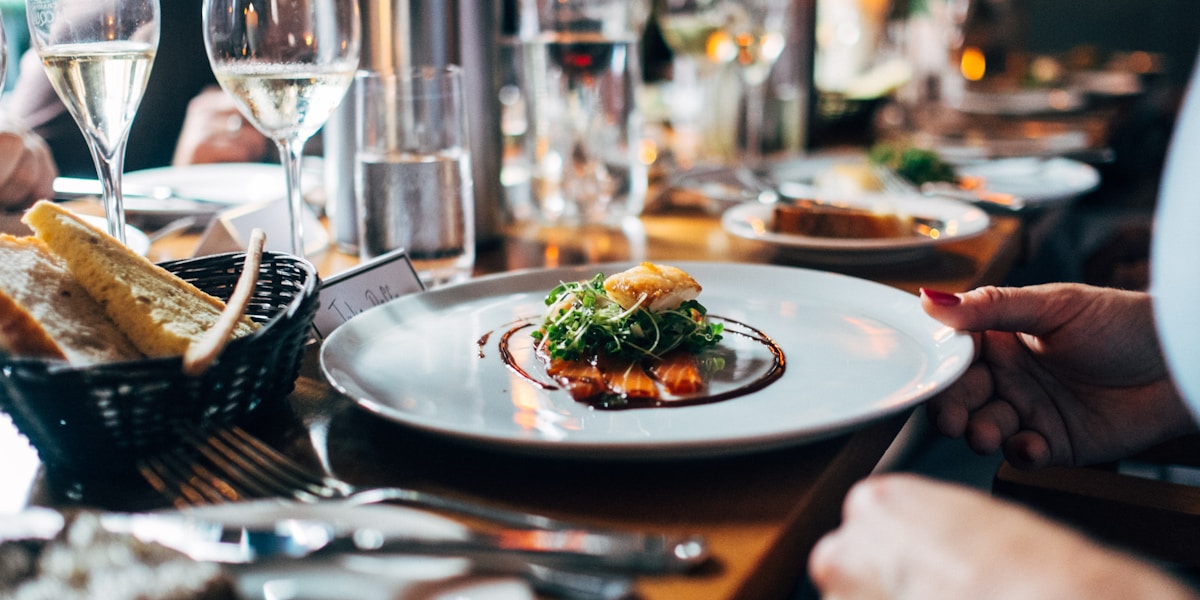
The address arrives by text message at 5pm on the day of the dinner. Before that, nothing. You have a reservation — confirmed weeks ago, paid in advance, non-refundable — for a restaurant whose name you found through a friend of a friend, whose chef you know only by reputation, whose menu you will not see until you sit down. The location turns out to be the ground floor of a private apartment building in a neighbourhood you associate with dry cleaners and parking lots.
This is fine dining in 2026. Or rather: this is one version of it.
The restaurant, as an institution, is not dying. But it is fracturing — splitting into forms that would have been unrecognisable a decade ago and are now, in certain cities, the most interesting places to eat.
The Ghost Kitchen Revolution
The pandemic did not create the ghost kitchen. It accelerated it to the point where acceleration became transformation.
A ghost kitchen — also called a dark kitchen, a cloud kitchen, a virtual restaurant — is a cooking operation with no dining room. No front of house. No ambient lighting, no curated playlist, no server who tells you about the specials as if performing a minor theatrical role. Just a kitchen, a delivery platform, and a menu designed for transport. The food travels. The experience does not.
In 2019, ghost kitchens were a curiosity. By 2021, they were a survival mechanism. By 2026, they are a significant portion of the food service economy in every major city. London has more ghost kitchen facilities than it has conventional restaurant kitchens. Bangkok's outer districts are ringed with shared ghost kitchen campuses where dozens of virtual brands operate from a single building.
The economics are brutal in their clarity. A conventional restaurant in a major city requires enormous fixed costs: rent, fit-out, front-of-house labour, licenses. A ghost kitchen requires a fraction of this. The margin on delivery food is thin, but the capital required to start is also thin. The result is a food service sector that is, at its edges, more entrepreneurial than it has ever been.
The Pop-Up as Destination
At the opposite extreme from the ghost kitchen — in every sense — is the pop-up dinner. Not the casual pop-up of the 2010s, the chef testing a concept in a borrowed space before committing to a lease. The new pop-up is a fully formed experience, often more demanding and more expensive than a conventional restaurant, that exists precisely because it does not have a fixed address.
The chefs running these operations understand something about hospitality that the conventional restaurant model obscures: scarcity creates desire. A restaurant that exists for one night, or one week, or one season, generates a relationship with its guests that a permanent establishment cannot replicate. The reservation is not just a booking; it is an event in itself. The dinner is not just a meal; it is something that will not happen again in quite this way.
In Bangkok, Tokyo, Copenhagen, and New York, a constellation of chefs is building significant reputations through this model. They have no restaurants. They have mailing lists, social accounts, and a standard of cooking that would merit permanent locations if they wanted them. Many do not. The freedom of impermanence — to cook whatever is interesting right now, to move between cities, to work with different producers and different spaces — is the point.
What Gets Lost
The disappearance of the conventional restaurant from certain parts of the food ecosystem is not without cost.
The restaurant as institution has always been more than a place to eat. It has been a gathering point for a neighbourhood, a place of employment for people who do not fit neatly into other forms of work, a setting for the conversations and occasions that constitute the social life of cities. The corner restaurant that has been in the same location for thirty years — where the owner knows your name and your usual order — is a form of urban infrastructure that no ghost kitchen or pop-up can replace.
The premium end of the market can sustain experimentation because its customers are paying for experience, and experience can be delivered in non-standard formats. The middle of the market — the neighbourhood restaurant, the affordable local — is where the pressure is most acute. Ghost kitchens have taken delivery business from these establishments without generating anything equivalent in its place.
The New Address
What is emerging, in the cities where food culture is most dynamic, is not a single model but a layered one. Ghost kitchens for convenience and value. Pop-ups for occasion and discovery. Permanent establishments for the things that permanence enables: the relationship between a restaurant and its neighbourhood, the accumulated knowledge of a kitchen that has been running the same menu for years, the particular comfort of a room where everything is familiar.
None of these formats is replacing the others. They are occupying different niches in the same ecosystem. The address — or the absence of one — is becoming a design choice rather than a default. And that, for anyone who pays attention to what and how we eat, is genuinely interesting.