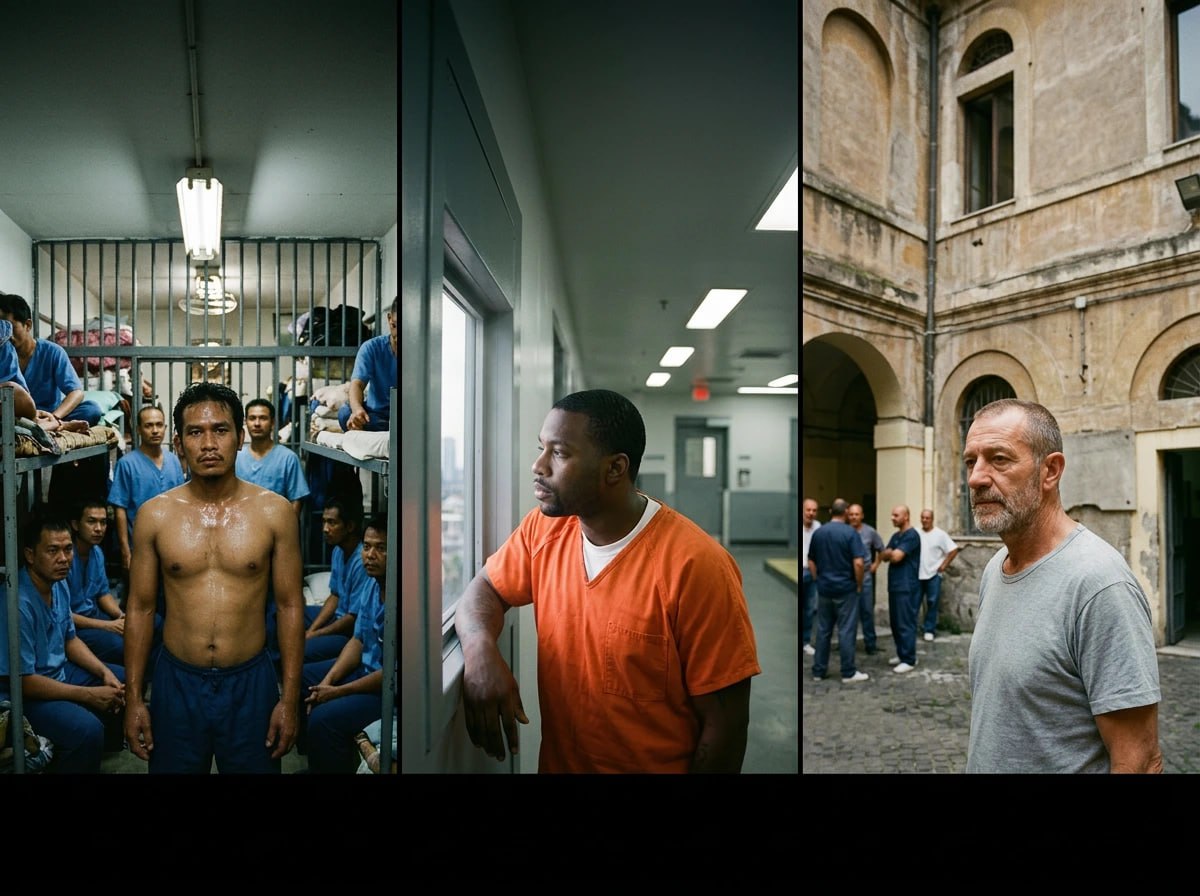
A comparative look at incarceration in Thailand, the USA, and Italy — based on real prisoner accounts and documented prison systems.
The same sun rises over three prison cells on the same morning. The men inside wake to different sounds, different protocols, different promises about what will happen next. This is not an essay about which country's prisons are "worst." It's about how three systems — one built on fear, one built on profit, one built on compassion interrupted by bureaucracy — create radically different realities from the same basic fact: a person behind bars.
04:30 AM — Bangkok, Thailand
Bang Kwang Central Prison (the "Bangkok Hilton," as British inmates call it with gallows humor)
The alarm sounds. Not a bell. A siren. The kind that makes your nervous system believe something catastrophic is about to happen. It happens every morning. Krit — a 34-year-old Thai national, arrested for drug trafficking three years ago — is already awake. He hasn't slept properly in months. The cell he shares with eleven other inmates is roughly 10 meters by 4 meters. The sleeping arrangement is geometric: you sleep where there is space.
He has no pillow. The "bed" is a woven mat. By 05:00, the reality of Bang Kwang asserts itself: it is one of Asia's most overcrowded prisons. Designed for 2,000 inmates. Currently holding 8,800. The air is thick. The smell — urine, unwashed bodies, something like rotting fruit from the buckets used as toilets — becomes a permanent part of your sense of smell.
Breakfast is rice soup. A single ladle, maybe 200 calories. There is no second serving. There is no choice. The hierarchy of Bang Kwang is rigid and visible. The long-term Thai prisoners occupy the better sections. The foreign inmates occupy the worse ones. Krit is at the bottom. He watches the power dynamics shift as guards rotate through. Some are gentle. Some are looking for bribes. A payoff to a guard can mean a place to sleep, a visitor, a letter delivered, medication for the infection spreading across your foot.
By 08:00, he is sitting on the floor in the main wing, making rope from coconut fiber. This is prison labor. He earns 50 satang per day ($0.015). It will take him 67 years of work to buy a single cigarette from the prison commissary.
By 20:00, lights don't technically go out — they never fully do. The noise doesn't stop. There is no silence in a prison with 8,800 inmates and 500 guards. He lies on the floor and stares at the darkness, thinking about the deal that got him here. He does not dream. He simply exists in a state between sleep and wakefulness until the 04:30 alarm sounds again.
06:00 AM — Atlanta, Georgia, USA
Fulton County Jail (a 22-story modern facility with surveillance cameras in every hallway)
DeShawn — a 28-year-old Black American, awaiting trial for armed robbery — is woken by C.O. Rodriguez with a plastic cup of watery coffee. "Count time. On your feet." He moves quickly. He has been here for eight months. The rhythm is automated. Cameras do most of the work.
His cell is smaller — a 2-man cell designed for 1.8 people. He shares it with Marcus, who was arrested for drug possession and has been waiting for trial for 11 months. The system moves slowly. They are warehouses waiting for court dates that keep getting postponed.
There is a metal toilet, a sink, a bunk bed. The mattress is thin plastic over something that might have been foam in the early 2000s. There is toilet paper, however. This is America. Even in jail, there is toilet paper.
Breakfast is oatmeal, a hard roll, a carton of milk. It arrives on a metal tray through the slot in the door. It is approximately 600 calories. By jail standards, it is adequate. DeShawn has a job. He works in the laundry for $0.25 per day. Over eight months, he's accumulated $20 in commissary credit. Everything in American jail is monetized. Phone calls cost $0.50 per minute. His mother put $50 on his account — the jail charged her a 3% "processing fee."
By 14:00, there is another count. He stands. He is counted. He remains standing until the guards leave because sitting without permission can result in punishment. By 20:00, he is back in his cell, listening to the sounds of the facility: televisions, men's voices, the hum of the ventilation system. He thinks about his trial, about the eyewitness, about the possibility of conviction and what 5-15 years means when you're 28.
07:00 AM — Rome, Italy
Regina Coeli Prison (housing ~900 inmates in a facility built for 500)
Marco — a 31-year-old Italian, arrested for drug distribution, serving the second year of a four-year sentence — wakes without an alarm. The rhythm of Regina Coeli is more human. He has a cellmate, Paolo, who has been here five years. They have developed a friendship. There is a window. An actual window with bars, yes, but a window that opens onto Rome. The connection to the outside world is not severed completely.
Breakfast is provided: bread, butter, jam, coffee. It's actually edible. There is dignity in the food here. It is not designed to be punishment. He has a job in the library. He earns €10 per week. The prison has a policy: education reduces sentence. Marco is taking classes. His high school diploma was never finished. Here, at 31 years old, he is in a GED program. The prison provides this.
By 09:00, he is in class. There are eight other inmates. The teacher is a volunteer from the University of Rome. They are reading Dante. The teacher treats them as students, not inmates. The difference is profound. By 11:00, there is time in the yard. The yard is small, but it exists. There is sunlight. There are other inmates. There is a quiet energy.
The visiting room at Regina Coeli has actual chairs and tables, not plexiglass. You can sit across from each other. You are permitted to touch your family member's hands. His sister brings news: their mother is managing. The family believes the appeal will work. She thinks they have a case. He allows himself hope. Hope is permitted here.
Evening time is free. He reads in his cell. Someone is playing guitar in another cell. Someone is laughing. Marco sleeps. He has nightmares sometimes, but the nightmares are not constant. There are nights when he simply sleeps, without terror.
The Comparison
Krit is in a system designed for punishment and survival. The Thai system is not cruel by intention; it is cruel by consequence. Overcrowding has made it so. Corruption has made it so. The belief that severe conditions prevent crime has made it so.
DeShawn is in a system designed for profit and management. The American system treats incarceration as a space of suspension where men wait for judges to decide their fate. There is competence here, but it is the competence of logistics, not justice.
Marco is in a system designed for redemption. The Italian system operates on a fundamental belief that people can change. That education matters. That dignity matters. That keeping someone alive and somewhat intact is better than destroying them slowly.
The differences are stark. A single day in these three prisons reveals the basic assumptions each country makes about human nature, punishment, and the purpose of incarceration.
What the Numbers Say
- Thailand: ~350,000 prisoners in a system designed for ~250,000. Recidivism rate: 70%. Average cell time per inmate: 22 hours. Cost per inmate annually: $2,000.
- USA: ~2.3 million prisoners (highest incarceration rate globally). Recidivism rate: 44%. Average cell time: varies, but roughly 16 hours. Cost per inmate annually: $35,000.
- Italy: ~60,000 prisoners in a system designed for ~48,000. Recidivism rate: 32%. Average cell time: 10 hours. Cost per inmate annually: $31,000.
The United States spends more than twice as much as Italy and has worse outcomes. Thailand spends far less than both and the outcomes are catastrophic. This is not about money. It is about philosophy.
The Day Ends
At 20:00, three men settle into beds. Krit stares at the ceiling of a cell holding 12 people. DeShawn reads a magazine on a thin mattress. Marco writes a letter to his sister. None of them chose this. But the systems that hold them have choices built into their very structure.
The question is not which system is less bad. It's what the choice to build these systems says about who we are.